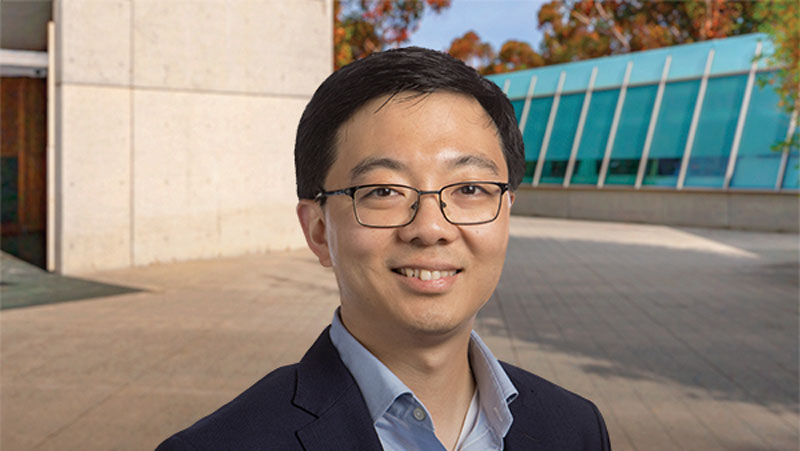
Li Ye, the N. Paul Whittier Chair in Chemistry and Chemical Biology at the Scripps Research and Howard Hughes Medical Institute Investigator, has been honored with the Tianqiao and Chrissy Chen Young Investigator Award from the Society for Neuroscience (SfN). Ye is one of seven early-career researchers whose awards will be presented during Neuroscience 2025, SfN’s annual meeting.
The SfN Tianqiao and Chrissy Chen Young Investigator Award recognizes the outstanding achievements and contributions of early career neuroscientists who demonstrate scholarly independence. The award is supported by the Tianqiao and Chrissy Chen Institute andincludes a $25,000 prize and complimentary registration and travel to SfN’s annual meeting.
“Innovative thinking often comes from those just beginning their scientific journeys,” says SfN President John H. Morrison. “These early career researchers are advancing neuroscience through breakthroughs in nanoscale imaging, new computational methods, neuroplasticity, and more.”
Ye’s research focuses on the complex interactions between the nervous system and somatic tissue, pioneering techniques that set new gold standards for studying neural activity in behavior and physiology. During his postdoctoral work, Ye was an early adopter who combined brain-clearing technologies with activity-dependent labeling strategies to enable high-resolution 3D imaging of intact neural circuits based on behavioral experiences. Subsequently, he developed an AAV-based and projection-specific activity mapping CAPTURE system (CLARITY-based Activity and Projection Tracking upon Recombination) and a whole-body tissue clearing method, HYBRID (hydrogel-based reinforcement of DISCO), both of which further enabled the interrogation of ultra-long-range brain-body communication in entire mammals. More recently, Ye developed CATCH (clearing-assisted tissue click chemistry), which enabled high-resolution, multiplexable in situ chemical imaging to visualize drug engagement in the brain.
Ye used these new technologies to study energetic communications between the brain and body under various physiological and disease conditions. These new models and discoveries not only uncover principles underlying brain functions with bottom-up inputs but also have broad implications for many peripheral and neurological diseases. Ye has received the NIH Director’s New Innovator Award, the NIH Director’s Transformative Research Award, and the Chan Zuckerberg Initiative Ben Barres Award for transforming how researchers visualize and analyze brain structure and function.
– Content provided by the Society for Neuroscience, with light edits for stylistic purposes. –