Award will support Assistant Professor Donghyun Raphael Park and graduate student Valery A. Ortiz’s research in imaging and ultimately designing therapies against the world’s deadliest bacteria.
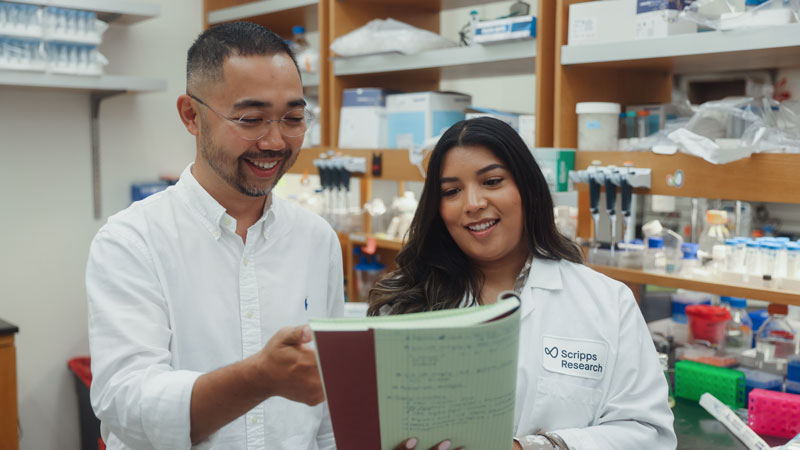
Developing new medicines for infectious diseases has historically been a slow and challenging process, in part because scientists haven’t had the right imaging tools to visualize and investigate basic bacterial mechanisms. At Scripps Research, Assistant Professor Donghyun Raphael Park and PhD student Valery A. Ortiz have been awarded the Howard Hughes Medical Institute (HHMI) Gilliam Fellowship to advance their research in this critical area.
The Gilliam Fellows Program is a prestigious, highly competitive award that selects just 30 student-advisor pairs from more than 800 applicants nationwide. It is designed to advance science by supporting exceptional PhD students committed to inclusive leadership and by investing in the mentorship development of their faculty advisor. The award honors the contributions and service of the late James H. Gilliam, Jr., a charter trustee of HHMI and a respected business and civic leader. Ortiz will receive an annual award of $65,000 for up to three years to support her PhD training and professional development. Park will participate in HHMI’s mentorship skills development course to further cultivate better lab environments. As part of the award, they will also create a project that engages their communities in the process of science and scientific discovery.
At Scripps Research, Park and Ortiz study how bacteria-killing viruses called bacteriophages infect mycobacteria and ultimately kill this human pathogen, using a cutting-edge imaging technique known as cryo-electron tomography (cryo-ET). Their ultimate goal is to design phage therapies effective at treating infectious diseases caused by mycobacteria, including Mycobacterium tuberculosis—the world’s deadliest bacterial pathogen and the cause of tuberculosis. Earlier this year, the Park lab published a study in Cell revealing the very first structural images of a tuberculosis-fighting virus. These insights could advance phage therapies and push the treatment landscape forward.
“The infectious disease tuberculosis claims more than a million lives each year—a toll that is expected to rise as the bacterium becomes increasingly resistant to existing drugs,” Park says. “This support from HHMI provides a unique opportunity not only to uncover how these therapeutic phages interact with mycobacteria, but also to foster more inclusive training environments through projects planned as part of the Gilliam Fellows Program.”
Ortiz adds, “In scientific research, real progress depends on close collaboration. I’m honored to receive the HHMI Gilliam Fellowship – not only because it directly supports my training and research, but because it reflects a commitment to building a more inclusive future in science. The Gilliam Fellowship will enable us to expand the frontiers of how we visualize infectious disease mechanisms and, in turn, help identify the treatments of tomorrow.”