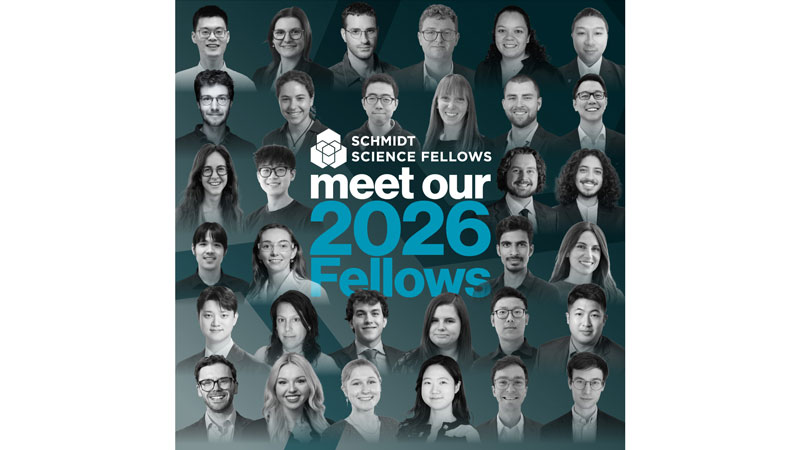
Credit: Schmidt Science Foundation
Abigail Reeves, a student at Skaggs Graduate School of Chemical and Biological Sciences at Scripps Research, has been selected as a 2026 Schmidt Science Fellow, one of the most competitive early-career science awards in the world. Reeves is the first student from Scripps Research’s doctoral program to receive this distinction.
Schmidt Science Fellows, a program of Schmidt Sciences delivered in partnership with the Rhodes Trust, was co-founded in 2018 by philanthropists Eric and Wendy Schmidt to accelerate scientific discovery by funding exceptional researchers who are willing to pivot boldly across disciplines. The 2026 Schmidt Science Fellows were nominated by 25 globally leading institutions across North America, Europe, Asia and Australia.
“We welcome the fresh, interdisciplinary perspective that each new cohort of Schmidt Science Fellows brings to the mysteries of our time—how life began on Earth, how we can overcome disease, how our climate is changing, and how we can create a healthy, resilient, and secure world for all,” said Wendy Schmidt, who co-founded Schmidt Sciences with her husband, Eric.
Reeves was nominated by Scripps Research following an internal competition open to the institution’s most promising doctoral candidates. As a fellow, she will receive $110,000 annually for up to two years to pursue a postdoctoral placement at a world-class research institution in a field distinct from her doctoral work. The program is designed to spark cross-disciplinary thinking that drives breakthroughs by encouraging experience in different research areas.
In May 2026, Reeves will receive her doctoral degree in chemical biology from the Skaggs Graduate School, where her research has focused on understanding how healthy placentas develop. Working at the surface of cells, she has studied how sugar molecules called glycans interact with proteins to regulate cell behavior during pregnancy. Because these interactions are fleeting and difficult to detect, she developed new laboratory tools to capture and identify them more reliably. Her findings illuminate what can go wrong in pregnancy complications such as preeclampsia and miscarriage, pointing toward potential targets for future drug development.
“Reeves is an outstanding young scientist whose creativity, rigor, and intellectual courage already distinguish her as a future leader in scientific research,” said Scripps Research professor Mia Huang. “I am incredibly proud of her for earning the Schmidt Science Fellowship—her achievement highlights both her individual excellence and the strength of the Skaggs Graduate Program, which fosters interdisciplinary training to prepare students to make impactful contributions across scientific fields. I am thrilled to see her become the first recipient from our institution.”
For her postdoctoral work, Reeves will pivot into immunology and bioengineering, applying her expertise to a new challenge: improving how the immune system recognizes and attacks gynecological cancers. She plans to build on promising therapies that genetically reprogram immune cells to target tumors, with the goal of making these treatments more effective against breast, ovarian and other cancers. Scientists have already demonstrated this approach in patients with blood cancers; Reeves aims to help extend its reach to solid tumors, where significant technical hurdles remain.
In addition to the research placement, Reeves will participate in a 12-month Science Leadership Program featuring residential convenings, mentorship from leading scientists and private sector leaders and a lifelong community of interdisciplinary researchers.
Reeves joins a growing global community of more than 200 Schmidt Science Fellows from nearly 40 countries who are committed to breaking down disciplinary barriers and tackling the world’s most pressing challenges.