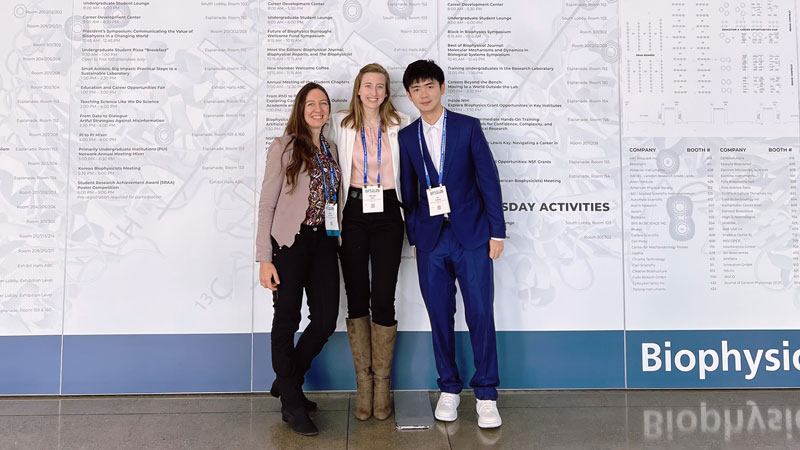
Kai Sheng, a postdoctoral researcher at Scripps Research, will be awarded a 2026 Outstanding Doctoral Research in Biophysics Award by the Biophysical Society during its 70th Annual Meeting.
Established in 2025, the annual award honors two outstanding doctoral researchers in biophysics, one based at a U.S. institution and one at an institution abroad. Sheng will be honored alongside the international recipient, Yiechang Lin of the Australian National University.
“Lin and Sheng jointly represent the most outstanding work being done by doctoral researchers at this time,” says Biophysical Society President Lynmarie Thompson of the University of Massachusetts Amherst. “I am delighted to honor the work of Lin and Sheng as the winners of the Outstanding Doctoral Research in Biophysics Award. They have both excelled in their respective biophysical studies and have been prolific publishers at an early stage of their careers.”
The Biophysical Society was founded in 1958 with the mission of leading and developing an innovative global community in the fields of physical and life sciences. Today, the Society has over 7,000 members dedicated to scientific excellence and harnessing the potential of biophysics to improve human health.
This award recognizes Sheng’s innovative methods that uncovered how bacterial ribosomes assemble, and his work creating the most detailed structural map of large ribosomal subunit assembly to date. Ribosomes, the molecular machines responsible for protein synthesis in all living organisms, assemble with remarkable speed and efficiency in bacteria, completing the process in roughly two minutes. That efficiency, however, makes the fleeting intermediates of assembly extremely difficult to study. Using advanced imaging and computational methods, Sheng resolved a series of intermediate structures that revealed how cooperative assembly blocks come together along parallel pathways to build the large ribosomal subunit. His work has provided the most detailed picture to date of how these essential molecular machines are built.
Originally trained as a chemical biologist at Peking University, Sheng previously received the J. Hammond Scholarship in Biophysics at Scripps Research for his ribosome research.
Sheng joins two other Scripps Research colleagues to be recognized at the annual meeting this year. Scripps Research Fellow Megan Ken has been selected to present at the Future of Biophysics Burroughs Wellcome Fund Symposium for her work quantitatively modeling the relationship between RNA structure and function in HIV. Irina Ritsch, a Branco-Weiss Fellow in the Peter Wright lab, has been selected to present at the New and Notable Symposium for her research on how hummingbird proteins resist shear stress, work that offers new insights into protein stability.