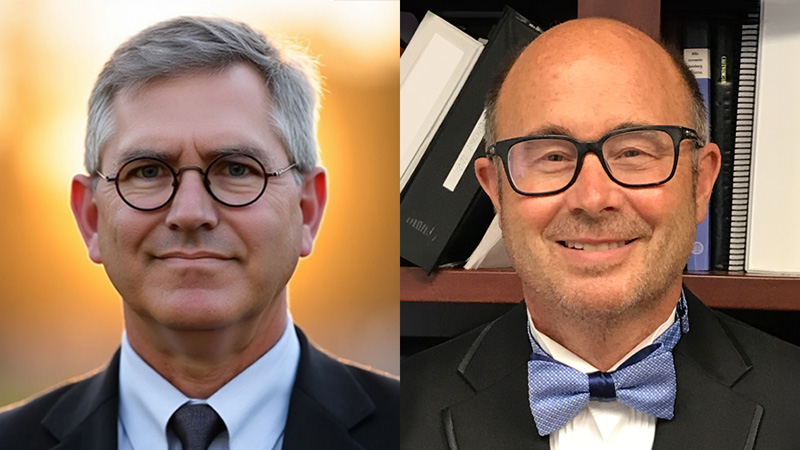
Scripps Research professors Jeffery Kelly, the H. Lutcher Brown Endowed Chair, and John Yates III, the John Lytton Young Endowed Chair, have been named laureates of the 2026 Canada Gairdner International Award, one of the most prestigious honors in biomedical science. The award recognizes researchers whose discoveries have made a major impact on scientific progress and human health.
Established in 1957 by philanthropist James A. Gairdner, the Gairdner Foundation was built to recognize major research contributions to the treatment of disease and alleviation of human suffering. Since its founding, the Foundation has bestowed 434 awards on laureates from more than 40 countries, and the Canada Gairdner International Award has become a defining recognition in the global biomedical community, with 103 past laureates going on to receive the Nobel Prize.
“The discoveries recognized by the Canada Gairdner Awards this year demonstrate how fundamental research can deepen our understanding of biology and lead to advances that improve health around the world,” said Janet Rossant, president and scientific director of the Gairdner Foundation. “We are proud to honor scientists who are expanding the frontiers of knowledge and shaping the future of medicine.”
Kelly has dedicated his career to understanding what happens when the protein folding process goes wrong. His foundational mechanistic research into protein aggregation has helped illuminate the molecular basis of protein aggregation diseases such as Alzheimer’s disease and transthyretin amyloidosis, the latter destroying the peripheral, autonomic and central nervous systems, in parallel with organ deterioration. Kelly’s laboratory discovered tafamidis, marketed by Pfizer as Vyndaqel® and Vyndamax®, which slows the progression of transthyretin cardiomyopathy and polyneuropathy and is taken by approximately 70,000 patients worldwide. Tafamidis was the first drug to slow the progression of a human amyloid disease, shifting the broader scientific consensus toward aggregation modulation as a viable treatment strategy and paving the way for the subsequently approved therapies targeting other protein-misfolding diseases. His contributions have earned him numerous honors, including the 2022 Breakthrough Prize in Life Sciences, the 2023 Wolf Prize in Chemistry and election to the National Academy of Sciences.
“I am deeply honored to receive the Canada Gairdner International Award alongside such extraordinary colleagues,” said Kelly. “This recognition belongs as much to the students, postdocs and collaborators who have driven this work forward as it does to me. Understanding how proteins misfold and aggregate has led to several first-in-class drugs, including tafamidis—the fact that ten aggregation modulators are now being used in patients to ameliorate several aggregation diseases makes this especially meaningful.”
Yates is a foundational architect of modern proteomics, the large-scale study of proteins and how they function within cells. He shares this year’s award with Professor Ruedi Aebersold of ETH Zurich and Professor Matthias Mann of the Max Planck Institute of Biochemistry. The award recognizes their collective contributions to establishing systems proteomics as a rigorous scientific discipline. Yates pioneered shotgun proteomics through the development of computational methods that enabled automated, large-scale identification of proteins from complex biological samples using mass spectrometry. His previous awards include the 2018 Thomson Medal from the International Mass Spectrometry Society and the 2019 Discovery in Proteomic Sciences Award from the Human Proteome Organization (HUPO).
“It’s humbling to be recognized by the Gairdner Foundation, an institution with such a remarkable legacy in biomedical science,” said Yates. “Proteomics has transformed how we study biology at a systems level, and I’ve been fortunate to work alongside brilliant scientists who pushed the technology further than we ever imagined possible. I hope this recognition reflects the entire field and the power of mass spectrometry to answer fundamental questions about life and disease.”