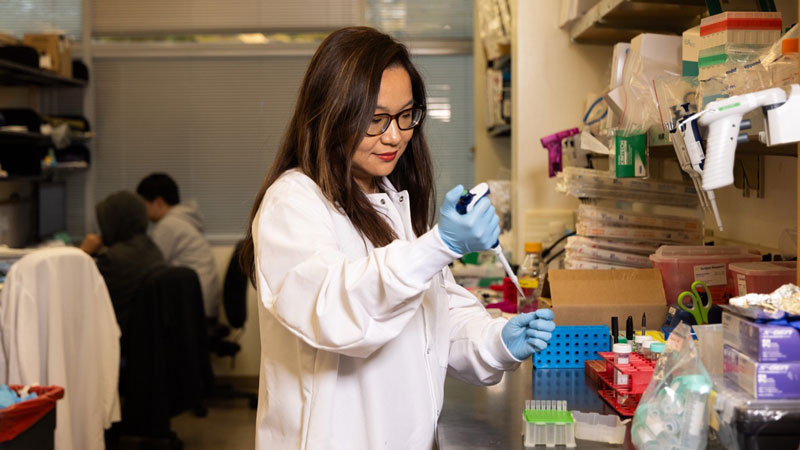
Xin Jin, an associate professor at Scripps Research and a Freeman Hrabowski Scholar at Howard Hughes Medical Institute, has been awarded a Sloan Research Fellowship for her exceptional research and leadership in the field of neuroscience.
The fellowship was established in 1955 by the Alfred P. Sloan Foundation and provides early-career researchers $75,000 over two years. This year, 126 researchers were selected out of more than 1,000 nominations by an esteemed, independent panel of senior scholars. The fellowships are awarded annually across seven fields: chemistry, computer science, earth system science, economics, mathematics, neuroscience and physics. Previous fellows have gone on to win 59 Nobel Prizes, 72 National Medals of Science, 17 Fields Medals in mathematics and numerous other awards.
“The Sloan Research Fellows are among the most promising early-career researchers in the U.S. and Canada, already driving meaningful progress in their respective disciplines,” says Stacie Bloom, president and chief executive officer of the Alfred P. Sloan Foundation. “We look forward to seeing how these exceptional scholars continue to unlock new scientific advancements, redefine their fields, and foster the wellbeing and knowledge of all.”
At Scripps Research, Jin’s lab addresses a critical challenge in neuroscience: Nearly 20% of American adults will experience serious mental illness during their lifetime, yet researchers struggle to understand how disease-associated genes cause problems at the cellular level. While human genetic studies have identified numerous genes linked to brain disorders, mapping their cellular mechanisms and determining which specific brain cell types are affected remains challenging.
To solve this problem, Jin developed a suite of functional genomic technologies, including in vivo Perturb-seq. This innovative gene-editing approach combines CRISPR technology with single-cell RNA analysis to enable large-scale functional studies of gene activity across diverse cell populations as the brain develops and matures. The technology can simultaneously examine hundreds of genes in hundreds of distinct cell types—compressing investigations that traditionally would have required years into experiments completed within days.
Jin’s team is now applying this approach to understand neuropsychiatric disorders by mapping how particular genes alter specific cell populations and neural structures during critical developmental windows. These findings could reveal how genetic variation and sex-based physiological differences converge to shape the brain’s trajectory in health or disease.
“The Sloan Research Fellowship enables my laboratory to push the boundaries of functional genomics and deepen our understanding of how genetic variation shapes brain development and homeostasis,” says Jin.
Jin’s previous recognitions include her selection as an HHMI Freeman Hrabowski Scholar and a 2024 Pew Biomedical Scholar, the McKnight Scholar Award, the Prebys Research Heroes Award, the 2023 Collaborative Innovation Award from Scripps Research and recognition as one of MIT Technology Review’s “35 Innovators Under 35” in 2022.
Other Scripps Research faculty who have received Sloan Research Fellowships include Mia Huang and Ann Kennedy (2023), Keary Engle (2019), Ryan Shenvi (2014), Jin-Quan Yu (2008), Phil Baran (2006), Philip Dawson (2001), M. Ghadiri (1993) and Kim Janda (1993).