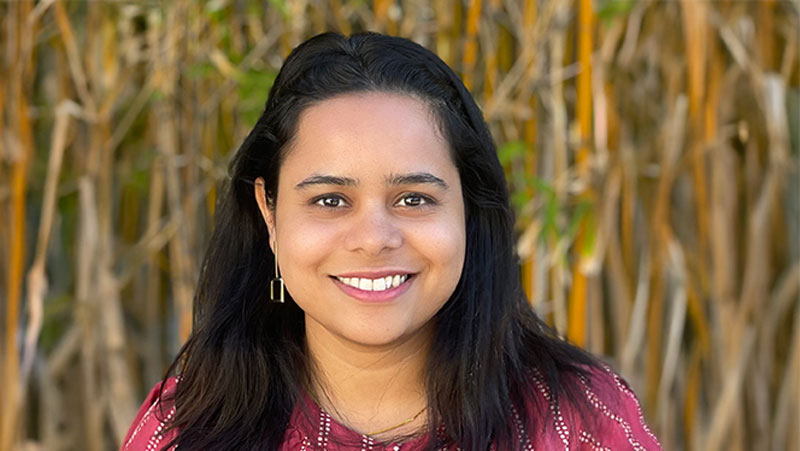
Zeba Rizvi, currently a postdoctoral research associate in Andrew Ward’s laboratory at Scripps Research, has been awarded a Postdoctoral Fellowship from the American Cancer Society (ACS) in recognition of her work to uncover how a key cancer drug target operates and why it sometimes stops working. The fellowship builds on research Rizvi initiated in the laboratory of Gabriel Lander, and she will continue advancing this work with support from the Ward lab.
Rizvi’s fellowship is part of a spring 2026 grant slate in which ACS announced an $80.7 million investment in 128 new cancer research grants across 71 institutions nationwide.
“Strong science starts with strong ideas, and this slate reflects the creativity and rigor of today’s cancer research community,” said William Dahut, Chief Scientific Officer of the American Cancer Society. “By supporting investigators at institutions across the country, we’re helping to sustain a research ecosystem that drives progress and expands what’s possible in cancer science.”
Rizvi studies a protein called cereblon (CRBN), a key substrate receptor of the CRL4 E3 ubiquitin ligase complex, that plays a central role in treating certain forms of multiple myeloma—a cancer of plasma cells that accounts for roughly 10% of all blood malignancies. CRBN is the primary target of a class of drugs called immunomodulatory drugs (IMiDs), including thalidomide and its newer derivatives. These compounds function as “molecular glues,” reprogramming cereblon to selectively recruit and degrade cancer-promoting proteins. Despite the clinical success of these drugs, researchers still don’t have a clear picture of how this process works at the molecular level, which has made developing better versions largely a matter of trial and error.
Using cryo-electron microscopy, a technique that produces near-atomic-resolution visualization of proteins, Rizvi is capturing step-by-step snapshots of the structural changes of CRBN as it undergoes dynamic conformational changes during drug binding and substrate recruitment. She’s also investigating why some patients with multiple myeloma eventually stop responding to these drugs—research that could reveal how cancer cells evolve to evade treatment and open new paths toward therapies that work even when current options fail.
“This fellowship will support my efforts to understand how cereblon works at the atomic level,” says Rizvi. “I hope that this work lays the groundwork for more deliberate, structure-guided drug design, helping move the field away from trial and error and toward therapies that can reach patients whose cancers no longer respond to existing treatment.”