Alejandra Mendoza is building a lab culture where discovery—and people—can thrive.
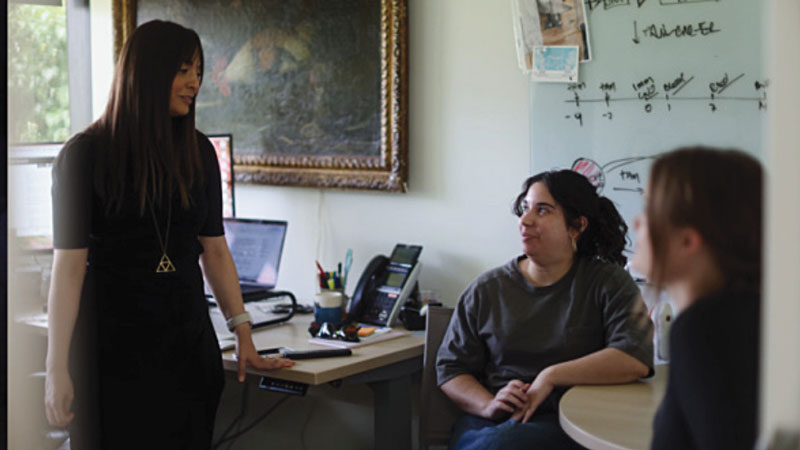
If you ask Assistant Professor Alejandra Mendoza her secret to mentorship, she’ll assure you there’s no easy, one-size-fits-all answer. If you ask her graduate student Abeera Mehmood, she’ll tell you it’s Mendoza’s combined “scientific brilliance with patience and empathy.”
Mendoza, who was honored with this year’s Outstanding Mentor Award, is focused on uncovering how our immune and nervous systems decide whether to attack or tolerate different stimuli. Specifically, she wants to know how dynamic cell types interact to maintain this balance between defending against harmful threats and permitting harmless ones. But she’s equally committed to supporting the next generation of scientists—and encouraging them to ask the bigger picture questions that drive the field forward.
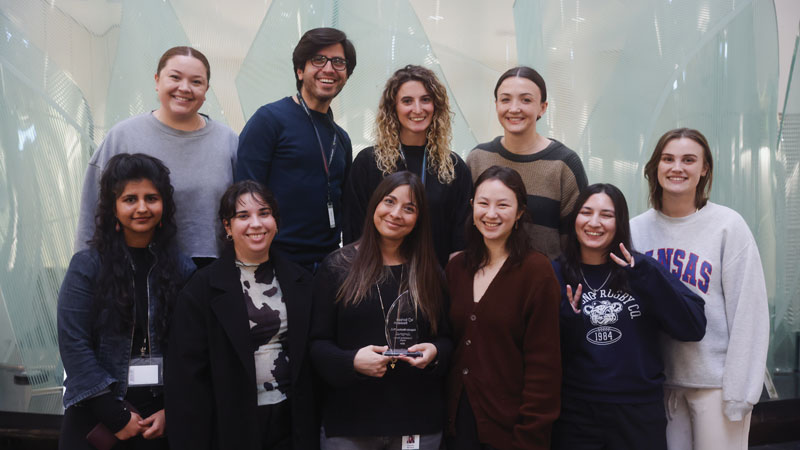
Scripps Research Magazine spoke with Mendoza to learn more about her personalized mentorship style, her advice for emerging researchers and even where she finds her one-of-a-kind antiques (oil paintings included).
Was there a particular moment or experience that first drew you to science?
I don’t come from a family of scientists, so science was a very abstract concept to me growing up. But I always loved those types of classes—chemistry, biology and math were my favorite subjects. I always thought I would be an engineer, since that seemed like the most practical application.
While I was born in the United States, my parents are Venezuelan, and we moved back there when I was six months old. I returned to the U.S. for college, and that’s when I first saw that people could be scientists for a living—not just famous textbook researchers like Marie Curie or Gregor Mendel.
How have past mentors helped guide your path?
Back in college, I was lucky enough to join a program that matched undergraduates from underrepresented backgrounds with mentors. The director of that mentorship program, Michael Gaines, was really devoted to helping establish the new generation of scientists and was a helpful gateway into the science field. I sent him an email when I got my position at Scripps Research, and he was so excited to hear where I had eventually landed. It was a full circle moment.
I also had an incredible PhD advisor at New York University (NYU), Susan Schwab, who understood that every graduate student and postdoc—even our technicians—has very different needs. She was a mentor beyond graduate school; for example, when I was practicing my seminar and “chalk talk” for faculty applications, Susan would come to my practices even though she was no longer technically my advisor. She was amazing, and I always think of her now as I’m leading my own lab.
And lastly, when I was completing my postdoc in Alexander Rudensky’s lab at Memorial Sloan Kettering Cancer Center, he would always walk around the lab and talk to everyone each week—despite our group being very large. Because his time was very precious, we all appreciated him taking the time to talk about experiments and the big picture implications of the work. He never lost track of how people were doing and how projects were developing. I try to emulate this in my lab, too.
As the recipient of this year’s Outstanding Mentor Award, how do you describe your mentorship style?
I take an adaptable approach with each lab member. Some I meet with weekly, while others have every other week check-ins. Our meetings may range from discussing the more practical, day-to-day experiments, to bigger picture questions and strategies. It can be hard to know what a person needs, and it’s definitely not one-size-fits-all.
I’ve been very lucky in that everyone I’ve recruited has been hardworking, smart, motivated and kind. They trust me enough to know that my feedback always comes from a good place. They do this with me, too—we’ve built a mutual trust, where they can tell me when I’ve done something they don’t necessarily agree with, or if they need something from me.
Science is as exhilarating as it is hard. It’s an uphill battle, and there are days where things are going well and then days where nothing is working. Trying to have empathy and providing a positive working environment are what I try to do to ensure we can all collaborate as seamlessly as possible, even during the more challenging times.
Do you have a piece of wisdom that’s stuck with you over the years?
As an undergraduate, I had the opportunity to meet Nobel laureate Susumu Tonegawa, who told me, “Pick mentors who have originality of thought. The ones who approach questions in ways that resonate with you. Even though you can’t really learn to be original, you can at least imitate their thought processes.”
This is why I specifically gravitated toward my graduate and postdoc mentors—I liked how they thought and conducted their research, and I think they shaped the way I think now.
How has this advice impacted your interdisciplinary research today?
When my lab asks larger questions like “What is the implication of this result? Why are we doing what we’re doing?” I try to explain my thought process explicitly, so that people can see how I approach it.
This is why having a diverse group of people in the lab is so critical. Having differing perspectives gives us various ways to approach questions, which means that we learn more and that we all become better scientists.
It’s especially important in our work, since we’re focused on taking tools from two different fields—neuroscience and immunology—and asking these bigger questions. We’re hoping to answer how cells in our tissues integrate information from a range of stimuli to respond to pathogens and damage, while inducing tolerance to beneficial or innocuous agents. Every day brings new discoveries in these areas, sometimes from unexpected places, and part of our job is to stay curious. To sometimes step outside our own particular disciplines, think about the larger picture and push the boundaries of science.
Outside the lab, how do you continue cultivating your own curiosity and growth?
I’m really into antiquing, and going to estate sales is my guilty pleasure. There are two things I wish to achieve this year. One is successfully restoring an old porcelain piece. The other one is having an exceptionally rare book find, like a first edition Alice’s Adventures in Wonderland by Lewis Carroll or Darwin’s On the Origin of Species. For my personal growth, I have been wanting to learn sign language. I have a familial connection to deafness but never learned how to sign. I guess I am hoping to change that now.