No drug is an island. From initial discovery to eventual approval, medicines take a winding and lengthy path, passing through numerous hands and organizations, typically reaching the market years—or even decades—later. If they do at all. In fact, roughly only 1 in 5,000 drug candidates that enter preclinical testing ever make it to the patient bedside.
Kim Janda, the Ely R. Callaway, Jr. Professor of Chemistry at Scripps Research, thinks about this figure often because many graduate students enter his lab eager to work on a therapy that could transform patients’ lives. While these goals are inspiring, they aren’t always achievable.
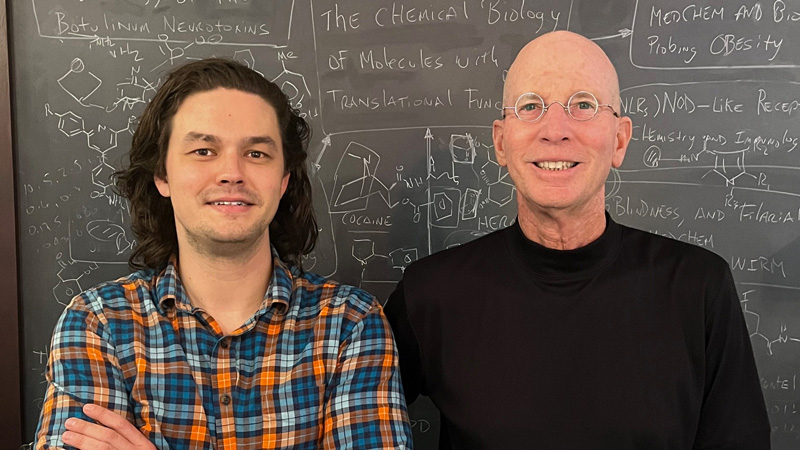
Now, two of Janda’s past laboratory members—both former students at the Skaggs Graduate School of Chemical and Biological Sciences—have done just that, by helping uncover the correct structure of a recently approved cancer medicine. In 2014, Nick Jacob and Jonathan Lockner joined the Janda laboratory ready to make their mark on biomedicine. Eleven years later, the molecule they studied—formerly known as “TIC10” and now marketed as Modeyso™ (dordaviprone)—has been approved to treat a rare genetic brain cancer.
“Out of everyone in academia, less than 1% have contributed to making a medicine,” Janda says.
In August 2025, Modeyso was approved to treat diffuse midline glioma (DMG) harboring specific genetic mutations—an ultra-rare, aggressive brain cancer that primarily affects children and young adults. Until now, there had been no FDA-approved treatment options for patients with this disease. The therapy is now owned and marketed by Jazz Pharmaceuticals.
Modeyso works by activating TRAIL, a tumor-suppressor protein that patrols the body for cancerous cells. Once activated, TRAIL binds to the ‘death’ receptors on the surface of tumors, triggering a cascade of signals that selectively destroys the cancer cells.
The path to understanding Modeyso’s mechanism began more than a decade ago at Scripps Research, when Janda’s group explored whether the compound could enhance the effectiveness of other molecules they were investigating as potential cancer therapeutics. In the process, they discovered that TIC10’s bioactive form had been chemically misassigned. To clarify its true structure, they combined a multitude of techniques—including two-dimensional nuclear magnetic resonance (2D NMR), which reveals detailed information about a molecule’s three-dimensional arrangement; X-ray crystallography, which precisely determines molecular shapes; and finally, total synthesis of the incorrect and correct structures. The third technique confirmed which molecule was the biologically active form.
After determining which structure was the correct link to the previous biology reported, Jacob, Lockner and Janda then published their findings in Angewandte Chemie in May 2014.
“By helping uncover TIC10’s true chemical composition, I believe we helped clear what had the potential to be a major roadblock to advancing it in the clinic—eliminating any ambiguity that would impact the necessary manufacturing, clinical readouts and, eventually, approval,” Jacob says. “It’s deeply gratifying to know that work we did at Scripps Research has contributed to an approved therapy that has changed the outlook for patients and families facing this devastating cancer.”
Modeyso joins a list of 17 other FDA-approved medicines Scripps Research has had a hand in advancing, including the rheumatoid arthritis blockbuster Humira® and the COVID-19 vaccines.
“The flywheel model at Scripps Research encourages our basic discoveries to eventually be pushed through clinical trials by additional organizations,” Janda says. “TIC10, or now Modeyso, is another poster child for why investing in academic research is necessary.”