Breakthrough medicines often take years—sometimes decades—to reach patients. ENCELTO™ and Modeyso™, two therapies recently approved by the U.S. Food and Drug Administration (FDA), highlight how foundational research and long-standing collaborations at Scripps Research can ultimately translate into new options for patients with rare and devastating diseases. With these approvals, Scripps Research has now had a hand in advancing 19+ FDA-approved medicines.

ENCELTO™ for a progressive eye disease:
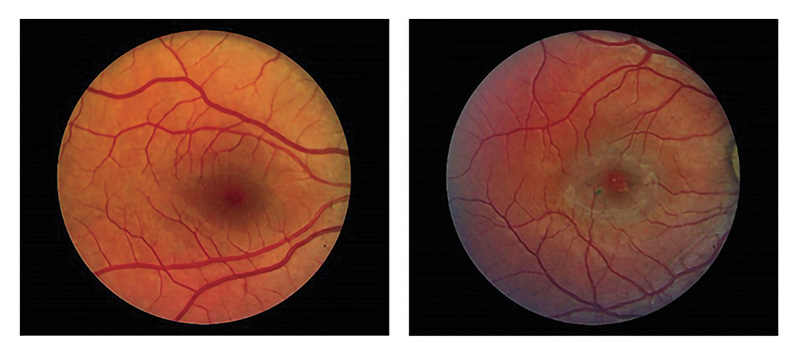
For people diagnosed with macular telangiectasia type 2 (MacTel)—a rare and slowly progressing retinal disease—there had been no FDA-approved (or other) treatments to slow or stop vision loss. That changed with the approval of ENCELTO (revakinagenetaroretcel-lwey), a surgically implanted device designed to preserve sight in people with this condition. Developed by the biotech company Neurotech Pharmaceuticals, ENCELTO’s origins stem from a long-standing partnership between the Scripps Research lab of physician-scientist Martin Friedlander and the Lowy Medical Research Institute. The FDA’s approval was supported by two phase 3 clinical studies showing that the ENCELTO implant slowed the loss of light-sensing retinal cells in people with MacTel over a 24-month period.
ENCELTO is also being evaluated for neurovascular degenerative conditions beyond MacTel. Friedlander’s lab is now exploring its potential to deliver other therapeutic molecules for diseases such as glaucoma and age-related macular degeneration.
Modeyso™ for a rare pediatric brain cancer:
In August 2025, Modeyso (dordaviprone) was approved to treat diffuse midline glioma (DMG) harboring specific genetic mutations—an ultra-rare, aggressive brain cancer that primarily affects children and young adults. Until now, there had been no FDA-approved treatment options for patients with this disease. Formerly known as “TIC10,” the molecule was studied more than a decade ago in the laboratory of Kim Janda, the Ely R. Callaway, Jr. Professor of Chemistry at Scripps Research, by then-graduate students Nick Jacob and Jonathan Lockner. Using two-dimensional nuclear magnetic resonance, X-ray crystallography and total synthesis, the team determined the correct structure of the biologically active molecule, helping clear a potential roadblock to its advancement in the clinic. The therapy is now owned and marketed by Jazz Pharmaceuticals.
19+ FDA-approved treatments have arisen from Scripps Research labs:
raxibacumab
A monoclonal antibody engineered to destroy the anthrax toxin, purchased by the U.S. government to protect against potential bioterror attack.
avelumab
The first treatment for patients with metastatic Merkel cell carcinoma, now used to confront other carcinomas as well.
belimumab
Debuted in 2011 as the first new lupus therapy in 50 years.
Developed in record time using key innovations from Scripps Research, these vaccines help protect people from SARS-CoV-2, the coronavirus that causes COVID-19.
ramucirumab
Treats advanced gastric cancer, liver cancer and metastatic, non-small cell lung cancer.
revakinagene taroretcel-lwey
A surgically implanted device designed to preserve sight in people with macular telangiectasia type 2 (MacTel).
adalimumab
Prescribed worldwide to treat arthritis and other autoimmune conditions.
cladribine, IV
Cures or offers a lifetime of remission for patients with hairy cell leukemia.
cladribine, oral
The first short-course oral medicine for patients with relapsing forms of multiple sclerosis.
dordaviprone
A medicine to treat diffuse midline glioma (DMG) harboring specific genetic mutations, an ultra-rare, aggressive brain cancer that primarily affects children and young adults.
Based on the discovery of Purified Factor VIII, this drug allows patients with hemophilia to lead practically normal lives.
pegvaliase-pqpz
A novel enzyme therapy for adults with phenylketonuria (PKU), a rare and serious genetic disease.
necitumumab
Treats metastatic squamous non-small cell lung cancer, used in combination with existing chemotherapies.
lucinactant
Prevents respiratory distress syndrome in premature infants and injured adults.
lenadelumab-flo
Helps prevent attacks of hereditary angioedema, a rare disorder that disrupts the normal flow of blood and other fluids in the body.
sacituzumab govitecan-hziy
Scientists used “click chemistry” to create this novel treatment for bladder cancer, urinary tract cancers and triple-negative breast cancer.
dinutuximab
In combination with chemotherapy, treats pediatric patients with neuroblastoma, a rare brain cancer.
tafamidis meglumine, tafamidis
Both medicines treat a debilitating, often fatal heart disease caused by protein buildup.
ozanimod
A once-daily oral medicine for patients with relapsing forms of multiple sclerosis.