A Q&A with Clinical Scholar Jacob New
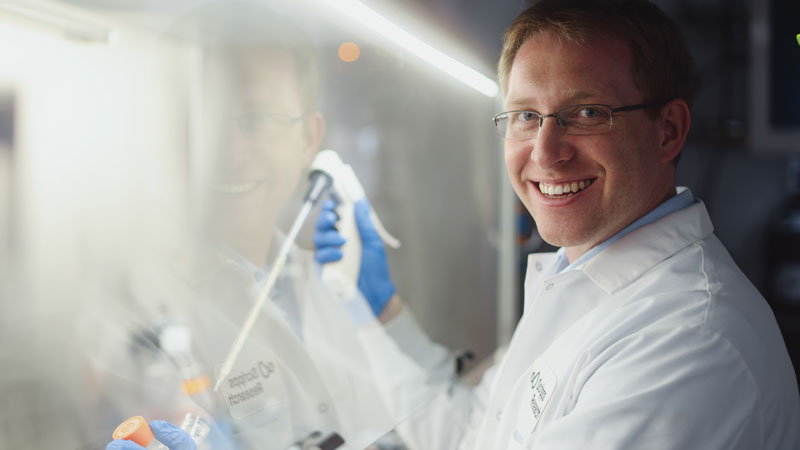
Despite improvements in screening, treatment and prevention, cancer remains the second leading cause of death worldwide. Jacob (Jake) New, a physician-scientist at the Scripps Research Translational Institute (SRTI), knows the impact and complexity of this disease all too well. As a medical oncology fellow at Scripps Clinic, he sees patients with various cancers that require individualized therapies and treatments. His work in the clinic has given him a unique perspective on the unmet needs of patients and their families, leading him to pursue further training in how to translate discoveries in the lab into interventions in the clinic.
The process of transforming laboratory discoveries into medical care—such as diagnostics, treatments and medical procedures—is known as translational science. Funded by the National Institutes of Health (NIH), the K Scholars Program at SRTI trains early career clinicians and scientists who are interested in a career that includes clinical and translational research. Trainees at SRTI, many of whom are medical residents and fellows at neighboring Scripps Clinic, conduct independent research under the mentorship of world-renowned faculty at Scripps Research, learning to use cutting-edge tools like genomics, artificial intelligence and digital technologies and refining their research skills.
New, who joined the program in 2023, is working on several studies related to cancer drug discovery and targeted therapies.
What drove you to pursue a career in oncology?
Growing up in Kansas, I knew a career in medicine would combine my love of science with the desire to help people. Like so many others, my family has been afflicted by cancer. It was my grandpa, who died from lung cancer, who started me on this journey.
As I got into medicine, I realized how many questions that affect the lives of cancer patients have yet to be answered. I chose to specialize in clinical oncology to try to better outcomes for these patients. By advancing targeted cancer therapies, we can make a big difference, not only in the lives of individual patients but for their families as well.
What attracted you to the K Scholars Program at the Scripps Research Translational Institute?
While I was at medical school, I met a lung cancer physician at an oncology conference who became my clinical mentor and introduced me to the translational medicine program at SRTI. Having looked at several training programs nationwide, the one at SRTI stood out. There’s nowhere in the country that you can do translational medicine training quite like here. I’ve had the opportunity to train at the bench under Professor Luke Lairson, an incredible mentor in chemical biology, while at the same time develop my own clinical trial under the guidance of Laura Nicholson, the director of education at SRTI, and the great clinical team at Scripps Clinic. The digital medicine group at SRTI has also been instrumental in giving me ideas and tools to enable my work.
What does your research focus on, and how do you hope it will impact human health?
I’m studying cancer in a multitude of ways. In the Lairson lab, we’re developing phenotypic screening and chemical biology tools to better understand the biology of cancer and what treatments could be most effective. We’re currently focused on a prodrug, which is a drug that doesn’t kill healthy cells, but switches its shape and turns into a pharmacologically active drug while in a cancer cell. We’re using large-scale genetic screens and flow cytometry to uncover how and why this drug activates in specific cancer types like glioblastoma, sarcoma and lung cancer. The goal is to tailor this therapy more precisely to patients.
Another major effort looks at oncogenes, which are the genes that drive cancer, in extrachromosomal DNA to see if we can target their regulation with new therapies.
In the clinic, I’m focused on better personalizing treatments based on how patients respond to immunotherapy, vaccinations and allogeneic transplants. A key area of investigation is bone marrow transplant patients, especially understanding and potentially predicting Graft-Versus-Host Disease (GVHD), a serious complication where the donor’s immune cells attack the recipient’s healthy cells. We’re using a mobile app-based study platform to monitor patients’ activity and health through the transplant process with the hope of intervening before complications like GVHD become life-threatening.
What do you like to do in your spare time?
I have two young girls, aged five and one, who keep my wife and me busy. We enjoy exploring San Diego with them. One of my favorite things to do is to cook with the family and host meals for others. My undergraduate degree was in food science. Cooking is a great way to learn patience, strategy and humility depending on how things turn out.