How Michael Constantinides is guiding the next generation of scientists
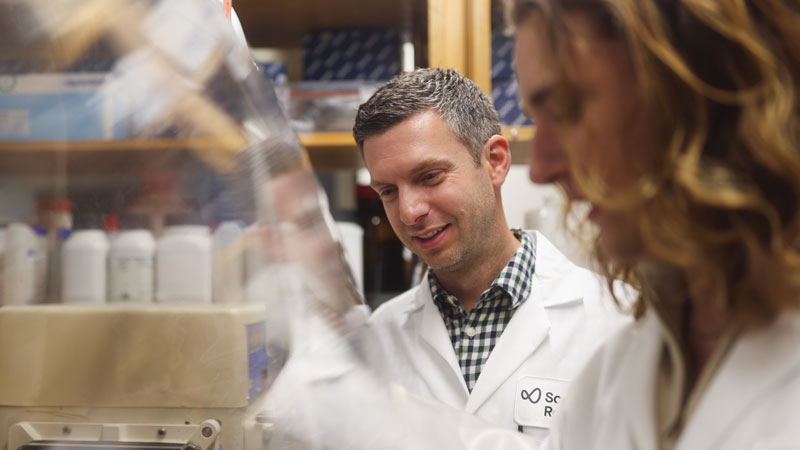
For Michael Constantinides, science is more than a search for answers—it’s a chance to guide others along the way. As an associate professor at Scripps Research, he’s as dedicated to mentoring young scientists and fostering a supportive lab culture as he is to conducting cutting-edge research. Constantinides’ lab studies how innate immune cells—the body’s first responders to infection and injury—protect barrier tissues like the skin and digestive tract lining. From helping graduate students navigate experiments to launching hands-on outreach initiatives for high schoolers, he’s working to make science more accessible, one conversation at a time.
Scripps Research Magazine spoke with Constantinides about the experiences that shaped his approach—and the power of showing students what’s possible.
What initially sparked your interest in science?
I was always fascinated by how things work. As a kid, I would take apart old equipment like telephones and remote controls. My parents realized they had to channel that curiosity, so they got me a chemistry set. I loved mixing chemicals and following instructions—that’s what first drew me toward science.
Then in high school, my AP Physics teacher encouraged me to explore research. He connected me with Greg Hillhouse, an inorganic chemistry professor at the University of Chicago, and I volunteered in his lab. Even though I didn’t know much about inorganic chemistry, a postdoctoral fellow mentored me through the experiments. That experience led to me becoming a national finalist in the Siemens Westinghouse Competition and a semifinalist for the Intel Science Talent Search—which earned me scholarships that helped cover my tuition at Princeton University, where I majored in chemistry. Through those early opportunities, I learned just how critical mentorship can be in opening doors to a scientific career.
How has your experience as a mentee influenced your approach to mentoring others?
I appreciate direct, honest feedback, and I sought out mentors who were very straightforward with me—no sugarcoating. But I’ve learned that different people have different needs. Some trainees thrive with direct feedback, while others benefit from more gentle encouragement. A key lesson I took from my own mentors is that it’s important to adapt your style to each individual rather than expect trainees to adapt to you.
What’s your approach to creating a supportive lab culture?
I have optional quarterly lunches with each member of my lab. It’s a casual way to get a better sense of what each person needs to succeed. I ask about their past experiences—what worked well, what didn’t—and tailor my mentorship accordingly.
It’s also important to normalize mistakes. I remind my trainees that mistakes happen all the time, and that I’ve made numerous ones throughout my career. I even share personal examples to show that they’re part of the process. Graduate school is full of hurdles, and being able to overcome them builds resilience for the future.
Which outreach initiatives are you most passionate about?
When I first joined Scripps Research, I wanted to expand outreach efforts to engage students who might not otherwise be aware of careers in science. That’s how I became involved with the REACH (REsearch Awareness for Community High schools) program, which has three components: outREACH, inREACH and a paid summer internship.
For outREACH, small groups of faculty, graduate students and postdoctoral fellows visit public high schools to share their career journeys and research. We make a point to visit schools south of San Diego—like Chula Vista and National City—where students may not have direct connections to science or medicine.
The inREACH component takes place on campus, and we provide transportation for high schools to visit Scripps Research for an event called Science Saturday. They participate in hands-on activities—like using virtual reality to visualize viruses or testing glucose levels in milk after breaking down lactose. Afterward, the students attend a poster session where they can talk with our researchers about ongoing projects.
Finally, the REACH summer internship provides high school students with a $5,000 stipend and seven-week placement in a lab, where they work closely with a Scripps Research graduate student or postdoctoral mentor. It’s an opportunity to experience real research while receiving guidance for college applications and future career paths.
Have you seen your outreach efforts directly impact a student’s path?
Absolutely. One of our REACH interns from last summer—who’s now a high school senior—recently shared his story with prospective applicants. Before his internship, he was planning to pursue medicine and wasn’t considering research as a career path. Working in Assistant Professor Ahmed Badran’s lab broadened his perspective, and now he’s seeing science as a field with many different entry points. It was meaningful to hear that the internship didn’t just provide a hands-on experience—it shifted his sense of what’s possible.
How can outreach programs help prepare future scientists for the job market?
There’s a huge bottleneck between postdoctoral training and faculty positions. To help address that, I started organizing the Future Leaders of Immunology Symposium. It’s a virtual event where talented postdoctoral fellows give full-length talks, practice answering questions, and get exposure ahead of the faculty application season. Because it’s online, the symposium draws broad participation—with more than 200 registrants in 2024—including faculty search committee members. Some of the speakers have landed interviews, and one was even hired at Scripps Research. These kinds of platforms can make a real difference in helping talented scientists move forward in their careers.
What advice would you give to your younger self—or to students starting out in science?
Enjoy the journey, not just the destination. When I was a graduate student, I was always focused on finishing my PhD as quickly as possible. Looking back, I wish I’d taken more time to appreciate the experience: being surrounded by smart, supportive colleagues and having the freedom to explore ideas without the pressures of funding or administration. Graduate school and postdoctoral training offer rare windows where you can take scientific risks without major consequences. I’d tell my younger self—and anyone starting out—to take advantage of that freedom, and to remember that every setback is part of the learning process.