After enduring decades of complications from Crohn’s disease, Gary Jacobson received a pioneering treatment from a Scripps Research professor that gave him relief and a renewed sense of control.
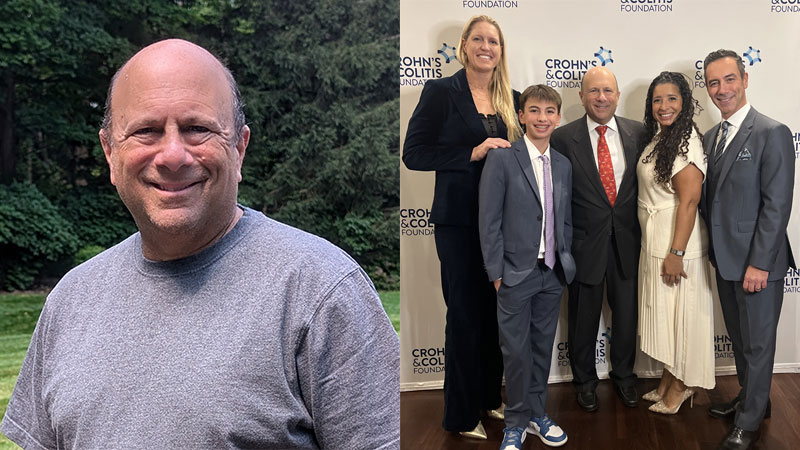
(Right) Gary Jacobson nominated Amy Lightner for the Crohn’s & Colitis Foundation Connecticut/Westchester Chapter Doctor of the Year Award and presented it to her in 2023. Amy Lightner, Josh Copper (Rising Star Award), Gary Jacobson (Ochs Volunteer Award), Jennifer Jara (Executive Director, Crohn’s & Colitis Foundation Connecticut/Westchester Chapter) and Michael Osso (President and CEO, Crohn’s & Colitis Foundation). Credit: Amy Lightner
Gary Jacobson has never been the type to stay still. A self-described former “Master of the Universe” from his 35 years on Wall Street, he’s traveled the world, raised a family and pushed through the grind of a high-pressure career. But for more than 40 years, nearly every aspect of his life has been painfully affected by Crohn’s disease: a chronic illness that can inflame any part of the digestive tract—from the mouth to the bowels—and result in unpredictable complications and flare-ups. The cause of the illness remains unknown.
“I’ve tried dozens of drugs over the years, been on steroids that drained the calcium from my bones, had 33 surgeries, cumulatively spent over a year in the hospital, and had several scary episodes—including a heart attack and septic shock,” recounts the 64-year-old from New York. “But many people think Crohn’s is just a dirty, ‘bathroom’ disease. And no one wants to talk about it.”
Living with Crohn’s, Jacobson has endured decades of pain, fatigue and a pervasive lack of solutions. What finally changed the trajectory of his illness was meeting physician-scientist Amy Lightner, now a professor of molecular and cellular biology at Scripps Research and a colorectal surgeon at Scripps Clinic.
Eleven years ago, Jacobson developed a complication known as perianal fistulas. These inflamed, tunnel-like tracts form between the anal canal and the skin near the anus. They’re often intensely painful and make daily life an exhausting battle with discomfort and the constant management of symptoms.
“I’ve had a lot of Crohn’s-related issues, but fistulas were the worst,” he says. “I had fistulas for seven years and would end up in the ICU when they got infected.”
While serving as president of the Crohn’s & Colitis Foundation Connecticut/Westchester Chapter, Jacobson learned about Lightner through one of his physicians at NYU Langone Health. Lightner was running clinical trials where patients received donor-derived stem cells injected directly into their fistula tracts to reduce inflammation and promote healing. Jacobson reached out. Three months later, Lightner called him back.
What followed were nine months of intense preparation and drives between New York and Ohio, where Lightner directed Cleveland Clinic’s Center for Regenerative Medicine and Surgery. It was the height of the COVID-19 pandemic, so flying wasn’t an option.
“I drove nearly 18 hours round-trip for 15-minute appointments,” recalls Jacobson. “I’d go to Ohio in the morning, stay overnight and come back the next day.”
On January 6, 2021, Jacobson finally received the stem cell treatment.
“I don’t even think about fistulas now,” he says. “I don’t use the word ‘cured’ lightly, but it feels like Dr. Lightner cured them. As for the rest of my symptoms, doctors are working hard to help, but no one else has stopped any other aspect of my disease.”
Jacobson is one of a growing number of patients benefiting from Lightner’s mission to push treatment of inflammatory bowel disease (IBD) beyond the current standard of care. IBD is a chronic condition that causes digestive tract inflammation, most commonly in the form of Crohn’s or ulcerative colitis (the latter of which specifically affects the innermost lining of the colon and rectum).
By studying organoids—tiny, three-dimensional cell cultures grown from human tissue that model how organs function—Lightner and her lab at Scripps Research are uncovering the root causes of IBD and exploring new therapies to promote healing where traditional methods fall short.
“We’re not just treating symptoms; we’re working to understand the biology of IBD so we can actually repair damage,” says Lightner. “That means thinking differently and being willing to try what hasn’t been tried before.”
Even with the fistulas healed, Crohn’s itself is currently incurable. Jacobson still sees a team of eight physicians and must take 16 drugs and vitamins each day—on top of monthly injections and infusions—to manage a laundry list of symptoms that include diarrhea, gas, joint stiffness, restless leg syndrome, sleep apnea, memory issues, hypertension and dysplasia (a precancerous condition involving abnormal cells in the colon, monitored via a colonoscopy every three months). But the most debilitating, says Jacobson, is chronic exhaustion.
“If I could get rid of the fatigue, I’d be willing to put up with the diarrhea,” he adds.
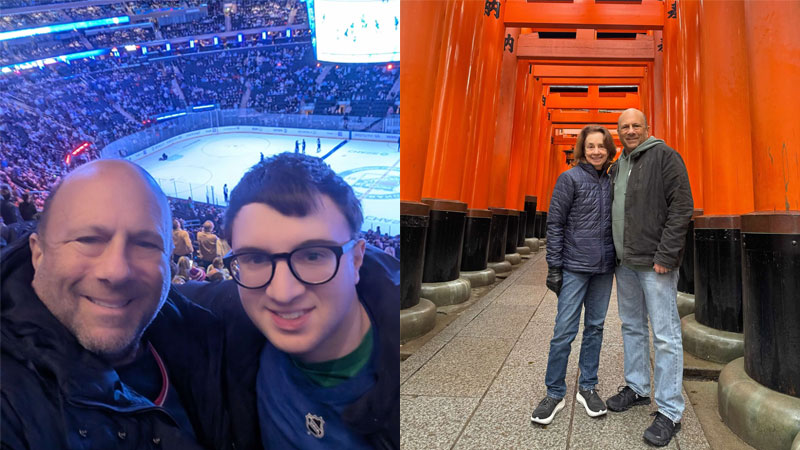
(Right) Jacobson with his wife, Beth, visiting Japan in March 2025. Credit: Gary Jacobson
Nevertheless, Jacobson lives fully. Earlier this year, he spent a 13-hour day out and about with his son—lunch, a comic book store, the Nintendo store in Rockefeller Center, dinner at the Hard Rock Cafe, and a New York Rangers hockey game to top it off—and didn’t need a bathroom once.
“I ate a light breakfast and doubled up on my anti-diarrhea pills; I do what I need to do to prepare,” notes Jacobson. “I don’t let Crohn’s define me, and I definitely don’t let it slow me down.” The following month, he visited Japan.
Cleveland Clinic estimates that 6–8 million people live with Crohn’s worldwide, and Jacobson hopes they can obtain the same level of care and commitment that he’s received from Lightner. According to Jacobson, what sets Lightner apart is that she goes beyond the science, pairing cutting-edge research with deep, personal investment in her patients’ outcomes.
“There’s still a major gap in tailored care for older adults with Crohn’s, and many doctors aren’t sure how to help us,” points out Jacobson. “Dr. Lightner is willing to push the envelope and try new things, like using stem cells to treat fistulas.”
Looking ahead, Jacobson is optimistic that new therapies—and perhaps even a cure—for Crohn’s could eventually be within reach. He also wants to see the stigma and persistent misconceptions surrounding the disease finally dispelled.
“We’re not contagious. We’re not dirty. But we’re living with something that most people don’t understand,” he says. “We’re normal people striving to live normal lives, and we need better treatments—and more doctors like Dr. Lightner.”