Antibiotics are easy to take for granted—until they stop working. These medicines underpin much of modern healthcare, from routine surgeries to cancer treatments to the management of chronic conditions. Yet bacteria are increasingly developing resistance to our most trusted drugs, and the pharmaceutical pipeline for new antibiotics has slowed to a trickle due to a lack of financial incentive.
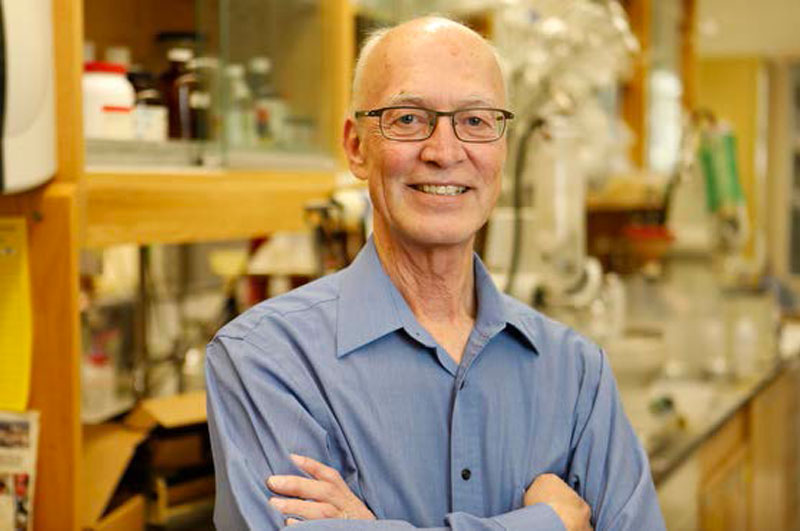
Despite these challenges, Dale Boger, the Richard and Alice Cramer Professor of Chemistry at Scripps Research, has spent years developing what he calls his “gift to humankind”: vancomycin analogs—modified versions of the antibiotic with strategic molecular improvements—that could remain effective for generations. Vancomycin is commonly used to treat infections of the colon and skin and has been a mainstay of broad-spectrum antibiotic treatment for over 60 years. Over time, however, bacterial genetic mutations have emerged to resist the effects of the medication, leading to incurable infections and even death.
But getting these molecules from the laboratory to patients involves a paradox—the very characteristics that make them invaluable for society make them unattractive to industry. Vancomycin is currently inexpensive to produce—costing pennies per dose—meaning there is little reason for pharmaceutical companies to invest in commercializing an improved version of the drug, according to Boger.
“We’re in a situation where vancomycin has been in the clinic for over 60 years, and resistance is just now emerging,” says Boger. “With our modifications, however, we’re not talking about extending its effectiveness by a few years—we’re talking about creating antibiotics that could last for centuries.”
To advance the development of this analog, Boger needs a partner to support the next steps of moving the molecules into pre-clinical studies and eventually clinical trials. But without additional funding, the analog is likely to sit on the shelf until antibiotic resistance becomes dire.
Engineering durability into antibiotics
Boger’s discovery began with understanding exactly how bacteria learned to evade vancomycin. Resistant bacteria modify their cell walls by activating a tiny molecular switch and swapping one type of atom for another at the site where vancomycin normally binds. This tiny substitution causes vancomycin to lose nearly all its grip on the molecule, reducing its binding strength by 1,000-fold. It’s a molecular escape trick that has allowed dangerous infections to spread unchecked.
Boger’s team countered with their own atomic swap in vancomycin’s “binding pocket,” the region of the molecule that latches onto bacterial cell walls. By making a subtle single-atom modification, they created molecules that can grip both the original bacterial target and the altered resistant version. This dual-binding capability means the modified antibiotic works equally well against both regular and resistant bacteria.
But Boger didn’t stop there. Recognizing that bacteria could potentially evolve around this single modification, his team added two additional modifications to different parts of the vancomycin molecule. Each targets bacterial cell walls through completely independent mechanisms, creating what scientists call “synergistic” effects—where the combined impact is greater than the sum of individual parts.
The first additional modification attaches to the sugar portion of vancomycin and blocks an enzyme that bacteria need to build their cell walls. This mechanism works regardless of whether bacteria have developed the resistance mutation. The second modification—added to the molecule’s tail end—introduces a positive charge that further destabilizes bacterial membranes by making them permeable, weakening their defenses through another independent pathway.
The result is a single molecule, which he calls “maxamycin,” that attacks bacteria through three simultaneous mechanisms. What makes this strategy particularly clever is that all three mechanisms work on the same target—the bacterial cell wall—but through different vulnerabilities.
“All three of the mechanisms of action are happening at the same time and place in the bacterial cell wall,” Boger notes. “This combined effect makes it nearly impossible for the bacteria to raise resistance simultaneously against all three mechanisms.”
It’s the molecular equivalent of attacking a fortress simultaneously from three different directions, as bacteria would need to develop three separate defenses at once—an evolutionarily improbable feat. In laboratory studies, the maxamycins did not become resistant even after extended exposure, unlike current frontline antibiotics. This multi-pronged approach is why Boger believes these antibiotics could remain effective not just for decades, but potentially for centuries.
Protecting the future of human health

For all its medical importance, the molecule’s name has surprisingly personal roots. During the Christmas holidays, Boger excitedly described his project to his then-nine-year-old grandson Max, who listened intently to every detail. When Boger finished, Max suggested naming the molecule after himself: maxamycin.
“The name maxamycin captures what makes this special,” Boger says. “It reminds me this molecule has the opportunity to serve his generation and those to come.”
That generation may desperately need it. The maxamycins target some of the most worrying antibiotic-resistant bacteria: vancomycin-resistant Staphylococcus aureus (VRSA) and vancomycin-resistant Enterococci (VRE). While resistance is just emerging, once vancomycin resistance percolates further into infections like methicillin-resistant Staphylococcus aureus (MRSA), there are few, if any, treatment options.
The commercialization conundrum
Despite its promise, the development of this vancomycin analog faces financial hurdles. Since entering the clinic in the late 1950s, vancomycin has become a staple for treating common infections that once would have caused serious complications or death. Its low cost, however, makes the effort to improve the drug through pharmaceutical pipelines unlikely, given its return on investment, according to Boger. While resistance is emerging, it hasn’t yet reached crisis levels in developed nations.
“The importance of developing this vancomycin analog is akin to what we saw in the COVID-19 pandemic when the decades of research on mRNA vaccines for coronavirus suddenly became critical to slowing the spread of disease,” explains Boger. “When it comes to antibacterial resistance, people aren’t looking for an alternative until there’s an urgent need for one.”
To make the drug available to patients, the analog would need to be evaluated in preclinical trials before identifying a pharmaceutical partner to manufacture the final product. Boger, however, hasn’t lost hope in the ability of this drug to reach those who need it most.
“As a chemist, these advances in drug discovery are exciting, but it’s the lasting impact on future generations—like Max’s—that make this work meaningful.”
Learn more about this technology and how to partner with Scripps Research through our Office of Technology Development.