How a scientist aims to close the gaps in addiction medicine
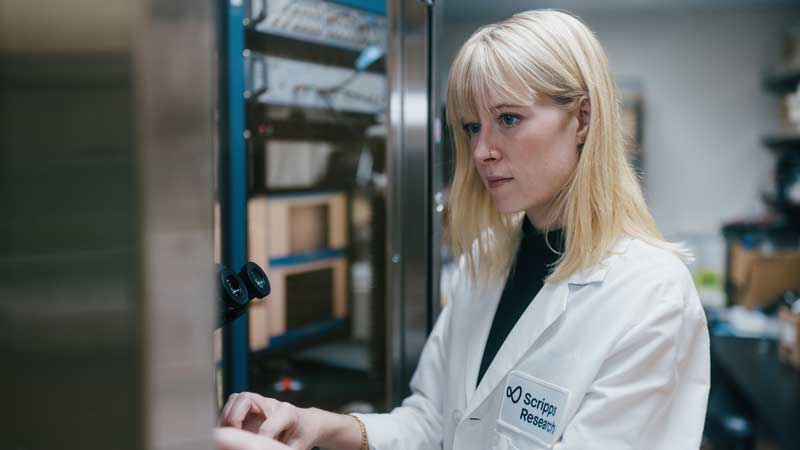
Chloe Erikson, a postdoctoral fellow in Marisa Roberto’s lab at Scripps Research, spent her high school summers in Monroe, Wash., volunteering at a sanctuary for abandoned farm animals, dreaming of becoming a veterinarian. Today, she’s taken quite a different path—one where she records electrical signals from individual brain cells called neurons, mapping how chronic alcohol exposure rewires the stress response system.
The career pivot happened during her first year at Washington State University when an introductory psychology lecture on alcohol dependence captivated her. She emailed the professor that same day, and within weeks, she was attending lab meetings and collaborating on research projects.
After completing her PhD in integrative physiology and neuroscience, Erikson joined the Roberto lab to tackle a critical gap in addiction medicine: understanding how alcohol use disorder (AUD) affects women’s brains. Her research focuses on the noradrenergic system in the central nucleus of the amygdala (a brain region that processes stress and emotional responses), and she’s finding that the female brain responds to alcohol dependence in fundamentally different ways than the male brain.
“I was fascinated to learn how the brain processes stress and drives different behaviors like addiction,” says Erikson. “The female brain is significantly understudied, and we can’t just assume that men and women have the same biological mechanisms. I want to be part of the team that brings better therapies to women with alcohol use disorder.”
Beyond the bench, Erikson is a passionate science communicator and participates in several programs aimed at engaging the next generation of researchers. When asked about her community engagement, Erikson lights up: “Working with high school students is one of my favorite things. At Scripps Research’s Science Saturday program this year, I led a group of students in building models of neurons out of pipe cleaners. I also demonstrated how I study the chemical and electrical properties of the brain.”
Erikson emphasizes that, to her, science isn’t just a career, but a community-driven pursuit to improve public health. According to the National Survey on Drug Use and Health, AUD is recognized as a public health crisis, with 1 in 10 adults in the U.S. having AUD as of 2024. Surprisingly, treatment options remain limited. The three medications approved to treat the disease—acamprosate, disulfiram and naltrexone—show inconsistent results, working well for some patients while providing little benefit to others. To understand why existing treatments are not as effective, Erikson focused on understanding how stress interacts with alcohol dependence and the role it has on brain activity in males and females.
When the brain experiences stress, neurons release noradrenaline, which binds to specialized proteins called receptors. Erikson’s research zeroed in on two receptor types: the first, alpha-1 receptors, increase GABA (gamma-aminobutyric acid) release—the brain’s “brake pedal” that calms activity and decreases stress. The second type, beta receptors, decrease GABA release, releasing the brake and driving increased activity.
In male rats, researchers found a clear pattern. Nondependent males only relied on alpha-1 receptors until they became dependent, at which point they recruited beta receptors. Female brains, however, use both alpha-1 and beta receptor systems simultaneously during all stages of drinking—indicating that medications that block both receptor types could be more effective for females in nondependence through dependence.
“Identifying the ongoing role of alpha-1 receptors in females gives us a valuable window to treat AUD more effectively,” says Erikson. “We’re one step closer to building the biological roadmap we need to develop better treatments for women.”
Having identified which receptors drive alcohol dependence, Erikson took a strategic next step: testing drugs that specifically block those receptors in females. She chose two medications already FDA-approved for other conditions: prazosin for high blood pressure and post-traumatic stress disorder (PTSD), and propranolol for anxiety and heart conditions. This approach could fast-track treatment development, since these drugs have already proven safe for human use.
Erikson found that prazosin reduced drinking in both nondependent and dependent females, while propranolol only worked in dependent females, indicating that propranolol may be effective specifically for treating severe alcohol dependence rather than moderate drinking.
Perhaps most importantly, Erikson found that alcohol dependence increases stress receptor expression in the central amygdala, and some changes persisted even two weeks after the animals stopped drinking. This biological rewiring may explain why people remain vulnerable to relapse after quitting—the brain’s stress system doesn’t reset when alcohol is removed.
“This research is filling a gap that’s existed for decades,” Erikson says. “Women’s brains respond to alcohol differently than men’s, and we’re finally mapping those differences. For the millions of women facing alcohol use disorder, this work could make all the difference in getting effective treatment.”
In her free time, Erikson enjoys playing competitive tennis and even took second place in her division at the United States Tennis Association national championship in 2025. Still an animal lover, Erikson unwinds with her cat, Theia, after a long day in the lab.