John Diekman is a founding partner of 5AM Ventures, a firm that funds and builds next-generation life sciences companies. He is also a valued advisor to Scripps Research, where he is in his second term as Chair of the Board of Directors. Sue Diekman, after heading the philanthropic division of a major corporation, now lends her expertise as a board member to several nonprofits. While their charitable interests are diverse, the energetic couple always takes a hands-on approach with their giving.
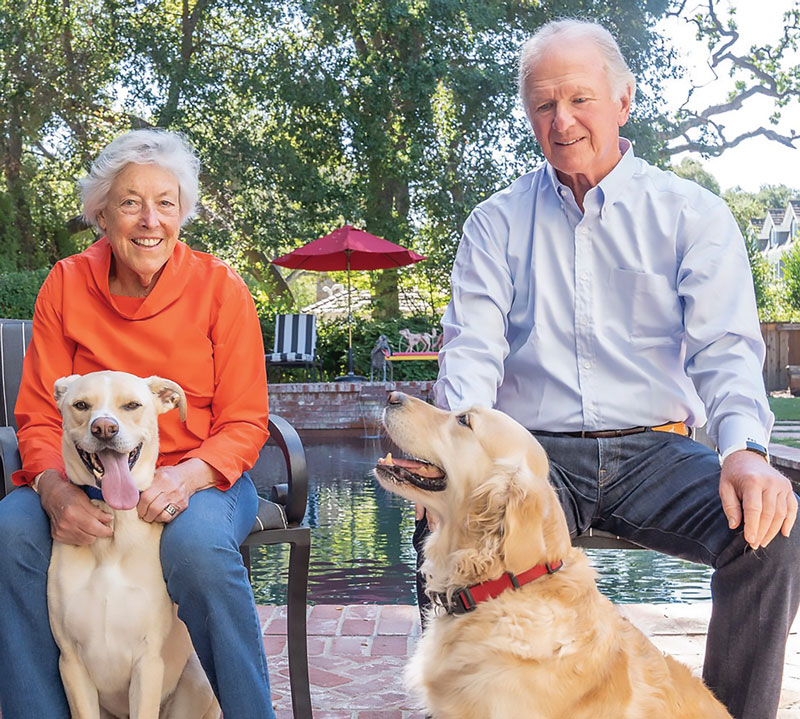
Your charitable pursuits are so varied—from art collecting and animal welfare to scientific research and healthcare. It seems you always take a hands-on approach when you get involved. Is that a personal tenet?
S: It’s not a conscious thing. But we tend to support organizations that we’ve already gotten to know, so we’re confident that our contributions will be well used to advance the organization’s mission.
J: Being closely involved with the biotechs that 5AM funded is one of the strategies that has led to mutual success. It’s one thing to donate money to a nonprofit and be done with it, but when you contribute your time and expertise, that can be just as valuable to the organization (as long as it’s not intrusive).
You each obtained advanced degrees at premier universities. After graduating from Princeton University, John, you earned your PhD in chemistry at Stanford University. And, Susan, you earned your master’s degree in education at Stanford. Have these experiences influenced your philanthropic contributions to Scripps Research?
J: They have. My mother, who did not go to college, always wanted me to get a science education at a top university and I did that at Princeton and Stanford. Scripps Research has one of the best graduate schools in chemistry and biology in the nation—the Skaggs Graduate School—and I believe it is just as important to the institute as the laboratory research. So, we have endowed a fellowship that will, in perpetuity, support a graduate student while they earn their PhD there. Previously we have sponsored an internship that brought an undergraduate student into a Scripps Research lab for 10 weeks. And we established a first-of-its-kind fellowship for San Diego-area science teachers that invited them onto campus, where they gained training that they could take back to the classroom.
S: I’ve always believed in giving teachers opportunities to deepen their subject knowledge, and Scripps Research does a great job of providing those opportunities.
John, when former institute President Richard Lerner asked you to be Board Chair at Scripps Research the first time, did you accept immediately or take time to think about it?
J: If you need to think about it, you shouldn’t have been asked. Serving as chair for an institute the magnitude of Scripps Research is an immense honor. I’m thrilled to have that as my legacy.
In 2017, President Pete Schultz asked you to return as Board Chair. How have you seen the institute evolve over the years?
J: Pete is just a fabulous chemist and an outstanding leader. He’s productive, he works hard and he cares so much about the institute. Richard Lerner had the same dedication. The quality and the output of the faculty at Scripps Research is exceptional. Not only is the academic climate great, but the on-campus environment, the community, is simply wonderful. It’s an enjoyable place to visit.
How do you envision your overall philanthropic legacy as a team?
S: We care about enriching people’s lives, be it through the human-animal bond, thought-provoking art or scientific research, which at Scripps Research translates to improved human health.