When grad student Byron Purse and postdoc Gudrun Stengel encountered a locked door on the Scripps Research campus one afternoon, a conversation sparked. They shared their scientific aspirations, compared travels in multiple countries. Then Purse located a key and the door to the labs—as well as a productive partnership—swung open.
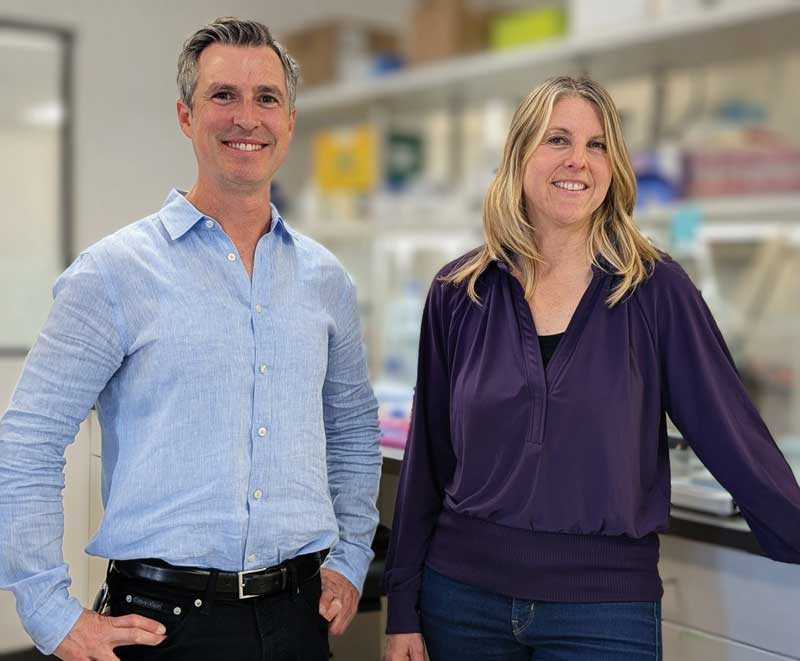
Today, Purse is a professor of organic chemistry at San Diego State University—although on weekends, you may spot him playing guitar with the up-and-coming Pat Shanley Band. He’s an academic at heart: “I love working with ambitious young scientists at the start of their careers.” A native of Canada, he earned his PhD at Scripps Research with Julius Rebek as his adviser. He chose Stockholm University for postdoc studies then returned to the U.S. to join the faculty at the University of Denver before moving his lab to San Diego.
Stengel, who was born in Germany and received her PhD at the Max Planck Institute, has an entrepreneurial spirit that caught fire during her postdoc work in the lab of Scripps Research professor David Millar. There, she explored the molecular machinery responsible for DNA replication. Subsequent stints at biotech giants Affymetrix (now part of Thermo Fisher Scientific) and Illumina gave her not only the skillset to build products but also made her realize the impact an essential platform could have in labs around the world.
With the field of epitranscriptomics—studying RNA modifications and their role in gene expression—gaining traction in recent years, Stengel and Purse, since married, saw opportunity. In 2020, they cofounded Alida Biosciences, a company developing novel tools that enable RNA modification-based discovery, diagnostics and therapeutics. It’s drawing global attention: Early in 2026, Alida entered a strategic collaboration with a biotech in England that is sending its candidate drug targeting an RNA-modifying enzyme, a first, into human clinical trials.
Now, the accomplished duo readily shares their expertise with Scripps Research graduate students and alumni. “I believe in paying it forward,” says Purse, who participates on career panels at the institute as well as advising its newly created Alumni Network. “So many projects and partnerships begin at the grassroots level, when you can talk face-to-face. Through the Alumni Network, for example, you can build new connections, refresh old ones and leverage the opportunities that being an alumnus of Scripps Research provides.”
“When you want to create something successful, it’s important to align the right people and the right tools,” adds Stengel. “That’s something Scripps has always been good at.”
Doors continue to open for these talented alumni. Whether applying their education and training in the lab, the classroom or the boardroom, they’re pushing scientific boundaries while mentoring researchers on the rise—extending a 100-year-old tradition that defines Scripps Research.